What 3D multiple-object tracking measures—and what it does not.
This page is the content source for scientific statements used in the campaign. Each approved wording block is tied to a population, protocol, measured endpoint, limitation, owner and review date.
Prepared by NeuroTracker scientific reviewLast reviewed 12 August 2026Next ledger review 5 November 2026
The task
A trained performance, not a clinical classification.
In 3D multiple-object tracking, a person identifies target objects, follows them among visually identical distractors, and selects the targets after motion stops. Performance can be described within that task.
Claims about transfer to working memory, attention in daily life, healthspan or disease risk need separate outcomes and stronger evidence. They are not inferred from an assessment score here.
STUDY SPOTLIGHT · UNIVERSITÉ DE MONTRÉAL
Training changes you can measure.
Measured changes in brain-wave patterns accompanied improvements in attention, working memory and processing-speed test scores.
BRAIN RECORDINGS
Brain-wave changes after five weeks.
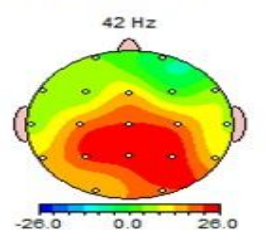
Researchers recorded participants’ brain waves before and after NeuroTracker training. This map shows how those patterns changed.
Warm colors: more gammaGreen: little changeBlue: less gammaGamma’s share of recorded brain-wave activity · trained group
Gamma is a fast rhythm linked to attention, memory and visual processing. The study found increases around visual-processing regions alongside the test-score improvements shown here.
View the published figure
The main map shows changes in one recorded brain-wave pattern (42 Hz · eyes open · relative power). Warm and cool colors indicate higher or lower relative power in that band.
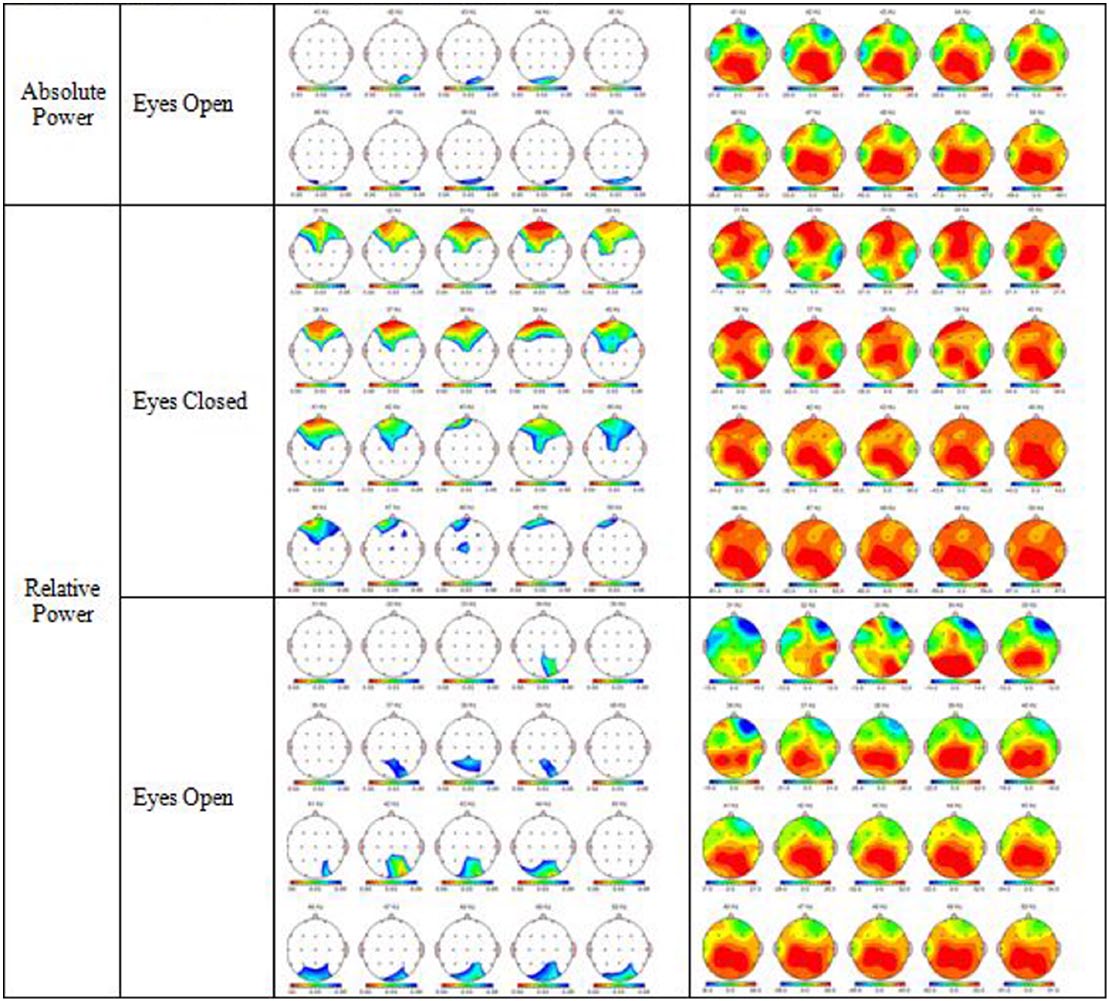
Figure 5 · The paper reported gamma changes at posterior recording sites, alongside gains on cognitive tests. Left panels: a statistical check of the before-and-after change. Right panels: how much the brain-wave readings increased or decreased.
COGNITIVE TEST RESULTS
What improved after training?
Gains in the trained group’s average scores on selected tests after five weeks.
+8.8%average test-score gain
Attention
Focusing on relevant information.
No training program: +1.7%
+12.9%average test-score gain
Working memory
Holding and organising information in mind.
No training program: +9.0%
+10.6%average test-score gain
Processing speed
Working through visual information quickly.
No training program: +8.5%
Changes in group-average test scores · 10 trained students and 10 comparison students without the program.
View the before-and-after scores
GroupBeforeAfterChange
Attention
IVA+Plus · auditory attention
Trained93.40101.58+8.8%
Control97.3098.98+1.7%
Working memory
WAIS · letter-number sequencing
Trained13.9015.70+12.9%
Control12.2013.30+9.0%
Processing speed
WAIS · coding
Trained91.40101.10+10.6%
Control88.0095.50+8.5%
Percentages compare each group’s average after score with its own before score. The three tests use different scoring scales.
Parsons et al. · Clinical EEG and Neuroscience · 2016 20 university students · 5 weeks · 10 training visits (30 tracking blocks)
Every scientific statement has a visible boundary.
SA-QEEG-003Approved for build
In a preliminary study of 20 university-aged adults, the NeuroTracker group showed measurable changes in resting qEEG activity after 10 training visits over five weeks.
Population
20 university-aged adults, randomly assigned to a NeuroTracker group (n = 10) or passive control group (n = 10)
Protocol
Ten 3D multiple-object-tracking visits, twice weekly over five weeks; each visit included three 20-trial tracking blocks (30 blocks total)
Measured endpoint
Pre-to-post changes in resting quantitative electroencephalography (qEEG) frequency power
Limitations
This was a small preliminary study in young adults with a passive rather than active control. It was not preregistered, does not show a younger brain or clinical benefit, and the authors cautioned that relative beta changes may reflect decreases in other frequencies. Two authors disclosed commercial affiliations with the NeuroTracker producer.
In a small study, healthy adults aged 64–73 improved on the trained 3D tracking task after five weekly sessions, with learning gains similar to younger adults.
Population
20 healthy adults aged 64–73 and 20 younger adults
Protocol
One 30-minute 3D multiple-object-tracking session weekly for five weeks
Measured endpoint
Performance on the trained 3D multiple-object-tracking task
Limitations
The five-week training experiment did not include a non-training control condition and did not test transfer to working memory, everyday functioning, diagnosis, lifespan, or dementia risk.
Evidence for improvement beyond the trained task is mixed, and a critical review found important methodological limitations across the NeuroTracker literature.
Population
Published NeuroTracker intervention studies included in a critical systematic review
Protocol
Critical systematic review of study design, outcomes and risk of bias
Measured endpoint
Strength and quality of evidence for cognitive and performance outcomes
Limitations
The review evaluated a heterogeneous and evolving literature; it does not establish that every protocol or population has the same result.
The NeuroTracker science library currently lists more than 120 published research papers and more than 100 research institutes using NeuroTracker.
Population
Publications and research institutes listed in NeuroTracker’s vendor-maintained science library
Protocol
Current public research-library and institutional-participation count
Measured endpoint
Number of listed published papers and research institutes
Limitations
These vendor-reported counts describe the breadth of the library, not the strength or direction of its findings. The library includes heterogeneous populations, study designs and outcomes, including assessment, association, intervention, review and limited or null findings.
In a small study of 12 NBA players, a one-session NeuroTracker baseline was associated with selected season performance measures, including turnovers and assist-to-turnover ratio.
Population
12 professional basketball players from one NBA team
Protocol
One approximately six-minute NeuroTracker baseline compared with season basketball statistics
Measured endpoint
Associations with assists, turnovers, assist-to-turnover ratio and steals
Limitations
This was a small correlational study from one team, not a training intervention. It cannot show that NeuroTracker training caused better decision-making or on-court performance.
In a small study of 12 Japanese professional baseball players, NeuroTracker performance improved across training; an analysis in six players also found promising trends in selected breaking-ball hitting measures.
Population
12 Japanese professional baseball players; selected hitting outcomes analysed in six players
Protocol
Approximately five months of 3D multiple-object-tracking training alongside pre-to-post hitting analysis
Measured endpoint
Multiple-object-tracking performance and selected breaking-ball swing and contact measures
Limitations
This was a small exploratory study without a randomised control group, and the hitting analysis included only six players. The findings require replication and do not establish a general performance benefit.
The NeuroTracker research library includes exploratory work in selected clinical and rehabilitation populations, including people with mild traumatic brain injury or cognitive impairment.
Population
Selected clinical and rehabilitation populations represented in the NeuroTracker research library
Protocol
Heterogeneous exploratory, feasibility, assessment and intervention studies
Measured endpoint
Study-specific task, symptom, cognitive or motor outcomes
Limitations
The existence of research in a population is not evidence that NeuroTracker diagnoses, prevents or treats concussion, dementia or any other medical condition. Results and methodological quality vary by study.
NeuroTracker’s current individual subscription offer includes a pair of compatible 3D glasses, subject to offer and shipping terms; its public pricing page also provides a standard free-trial route.
Population
Prospective individual NeuroTracker customers
Protocol
Current public individual subscription and free-trial offer
Measured endpoint
Product inclusion and available acquisition routes
Limitations
Product inclusions, trial availability, eligibility, shipping and commercial terms can change. The live pricing and checkout terms control at the time of purchase.
NeuroTracker can be used in 2D while a user waits for 3D glasses, and NeuroTracker’s supplied 3D glasses are designed to fit over most prescription glasses.
Population
Prospective and current individual NeuroTracker users
Protocol
Current public product guidance for home NeuroTracker use
Measured endpoint
2D availability and compatibility of supplied 3D glasses with prescription eyewear
Limitations
Fit and viewing comfort vary by person and prescription frame. Current product instructions and accessibility guidance control at the time of use.
Individual NeuroTracker users can cancel subscription renewal from the settings section of the NeuroTracker application, and product or billing questions can be sent to the NeuroTracker support team.
Population
Individual NeuroTracker subscribers and prospective customers
Protocol
Current public subscription-management and support guidance
Measured endpoint
Self-service renewal cancellation and access to customer support
Limitations
Organisation accounts follow a separate support process. Current subscription, cancellation and support terms control at the time of use.
NeuroTracker is designed to train high-level perceptual-cognitive skills including attention and focus, working memory, processing speed and reaction time, multitasking, spatial and situational awareness, decision-making and response control.
Population
Prospective and current individual NeuroTracker users
Protocol
Current public NeuroTracker brain-training benefit categories and product positioning
Measured endpoint
Perceptual-cognitive skills targeted by the adaptive 3D multiple-object-tracking task
Limitations
These are intended training targets and product benefit categories, not guaranteed individual or clinical outcomes. The strength of evidence and transfer beyond the trained task varies by skill, population and study design.
Owner / review
NeuroTracker product marketing and scientific review · 2026-09-12
Getting better at a task and changing everyday function are different questions.
Task learning means performance improves on the activity that was practised. Near transfer asks whether improvement appears on a similar, untrained task. Far transfer asks whether it changes a more distant ability or daily outcome.
The campaign reports the trained-task evidence and does not silently promote it into a working-memory, longevity, mortality, dementia-prevention or clinical claim.
Funding and editorial context
This partner experience is produced and operated by NeuroTracker for Super Age readers. NeuroTracker maintains the product experience and claim ledger. The linked papers have their own funding and conflict disclosures, which should be reviewed in the source.
Your next step
Discover your brain score.
Create your free account, take the assessment and unlock your personal report.